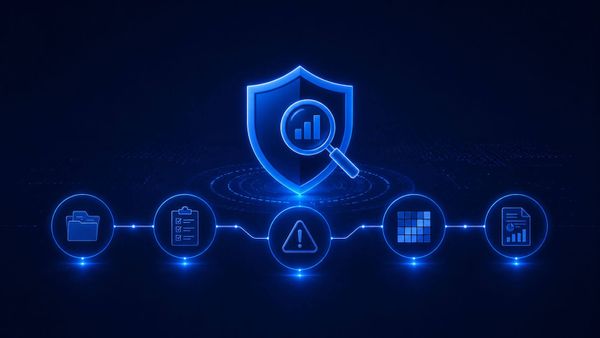
Continuous Monitoring Systems
For years, accounts payable (AP) controls have been designed around a simple premise: catch issues before or after payments are made. Pre-payment controls aim to prevent fraud and errors. Post-payment audits aim to detect what slipped through.
But in today’s environment, where fraud schemes evolve rapidly, payment volumes are rising, and digital channels accelerate transaction speed, that model is no longer sufficient. AP and finance leaders need something more dynamic, more responsive, and more intelligent.
They need continuous monitoring.
Continuous monitoring transforms disbursement controls from static checkpoints into a real-time, always-on defense system that detects risk as it emerges and adapts to changing conditions and patterns over time. This is where technology and automation play a critical role.
What Is Continuous Monitoring?
Continuous monitoring is the use of technology, analytics, and automation to observe, analyze, and respond to disbursement-related activity in real time or near real time.
Instead of relying on periodic reviews, batch reports, or manual oversight, continuous monitoring systems:
- Evaluate transactions as they occur
- Identify anomalies, inconsistencies, and high-risk patterns
- Trigger alerts, workflows, or automated interventions
- Continuously refine detection models based on new data
The result is a shift from reactive detection to proactive risk management.
For AP and finance leaders, this means fewer surprises, faster response times, and greater confidence that controls are working as intended.
Why Continuous Monitoring Matters Now
The need for continuous monitoring is driven by several converging trends:
- Increasing fraud sophistication. Fraudsters are leveraging automation, artificial intelligence (AI)-generated communications, and social engineering tactics to exploit weaknesses in traditional processes. Static rules and manual reviews can’t keep pace. These attacks are no longer isolated or opportunistic. They are coordinated, persistent, and designed to mimic legitimate business activity. Fraudsters study internal processes, approval patterns, and vendor relationships to identify the easiest points of entry. Without continuous monitoring, organizations often detect these schemes only after financial loss has occurred.
- Faster payment cycles. With the rise of ACH, real-time payments, and virtual cards, the window to detect and stop fraudulent or erroneous payments is shrinking rapidly. In many cases, once a payment is released, recovery becomes difficult or even impossible. This puts enormous pressure on AP and finance teams to identify risks before or at execution. Continuous monitoring enables organizations to match the speed of modern payment methods with equally fast detection and response capabilities.
- Growing transaction volumes. AP teams process more invoices, vendors, and payments than ever before, often with leaner staff. Manual oversight simply doesn’t scale. As organizations grow, the complexity of disbursement activity increases exponentially, not linearly. This creates more opportunities for errors, exceptions, and fraudulent activity to go unnoticed. Continuous monitoring allows organizations to maintain control and visibility regardless of volume, without adding headcount.
- Expanding regulatory expectations. Frameworks like Nacha’s risk-based monitoring requirements reinforce the need for ongoing, documented oversight of transactions and controls. Regulators and auditors increasingly expect organizations to demonstrate not just that controls exist, but that they are actively enforced and continuously evaluated. Point-in-time reviews and static documentation are no longer sufficient to meet these expectations. Continuous monitoring provides the audit-ready evidence and traceability needed to support compliance in a dynamic risk environment.
Continuous monitoring addresses all these challenges by embedding intelligence directly into the disbursement process.
How Continuous Monitoring Systems Work
At the core of continuous monitoring are systems that combine data integration, analytics, and workflow automation. While implementations vary, most continuous monitoring systems include the following capabilities:
Data aggregation across the disbursement lifecycle.
Continuous monitoring systems pull data from multiple sources, including:
- Enterprise resource planning (ERP) systems
- AP automation platforms
- Payment processors and banks
- Vendor master files
- Invoice and transaction records
By aggregating this data, the system creates a holistic view of disbursement activity, enabling more accurate analysis and decision-making.
Real-time transaction analysis.
As transactions are initiated, approved, and processed, the system evaluates them against:
- Predefined rules
- Behavioral patterns
- Risk indicators
This allows the system to identify anomalies at the moment they occur, rather than after the fact.
Anomaly detection and risk scoring.
Advanced continuous monitoring systems go beyond simple rules by applying statistical models and machine learning to:
- Identify deviations from normal behavior
- Detect subtle patterns that may indicate fraud or error
- Assign risk scores
This enables AP and finance teams to prioritize their attention where it matters most.
Automated alerts and workflow triggers.
When a potential issue is detected, continuous monitoring systems can:
- Generate alerts
- Route transactions for additional approval
- Pause or block high-risk payments
- Initiate verification workflows
This ensures that risks are not only identified but acted upon quickly.
Continuous learning and improvement.
Modern systems continuously refine their models based on:
- Historical data
- Investigation outcomes
- Emerging fraud patterns
This creates a feedback loop that improves detection accuracy over time.
Connecting Continuous Monitoring to the Four Pillars of Disbursement Controls
Continuous monitoring is the engine that reinforces and connects the four pillars of Disbursement Controls: Verify, Validate, Control, and Monitor.
Verify: Continuous monitoring ensures vendor verification is ongoing, flagging suspicious onboarding activity and real-time changes to vendor data.
Validate: It continuously checks payment and vendor data for anomalies, ensuring integrity beyond initial validation.
Control: Continuous monitoring dynamically enforces policies, detects violations, and ensures controls are functioning as intended.
Monitor: It transforms monitoring into a real-time, proactive capability rather than a retrospective exercise.
Advanced Continuous Monitoring Capabilities
For organizations looking to elevate their disbursement controls, advanced continuous monitoring capabilities offer significant advantages.
These capabilities move beyond basic rule-based detection and introduce a more intelligent, adaptive layer of oversight. They enable finance teams to uncover risks that would otherwise remain invisible in siloed or static environments.
As a result, organizations can shift from managing exceptions to proactively managing risk. This is where continuous monitoring becomes a strategic advantage.
Behavioral analytics. Instead of relying solely on rules, behavioral analytics establish a baseline of “normal” activity. They detect deviations such as unusual payment timing, frequency, or vendor behavior. This is particularly effective in identifying sophisticated fraud schemes that bypass traditional controls. Behavioral analytics continuously evolves as new data is introduced, allowing it to adapt to changing business conditions and seasonal patterns. It can distinguish between legitimate anomalies and suspicious activity, reducing false positives. Over time, this improves detection accuracy and operational efficiency. It provides contextual awareness that static rules cannot replicate.
Cross-system correlation. Advanced systems correlate data across multiple systems to uncover hidden risks. They link vendor changes, invoices, and payments to identify inconsistencies. This holistic approach provides deeper insight into potential issues. It reveals cause-and-effect relationships across the disbursement lifecycle. This is especially valuable for detecting multi-step fraud schemes. It also identifies breakdowns in controls or data inconsistencies across platforms. Ultimately, it creates a unified and accurate view of financial activity.
Risk-based monitoring models. Not all transactions carry the same level of risk. Risk-based models prioritize scrutiny based on vendor, transaction, and contextual risk factors. This helps AP and finance teams focus their efforts more effectively. These models incorporate factors such as transaction size, vendor history, and recent changes. They dynamically adjust monitoring intensity based on risk levels. This ensures high-risk activity receives immediate attention. It also reduces alert fatigue by filtering out low-risk noise.
Integration with payment systems. Continuous monitoring systems integrate directly with payment platforms to enable real-time intervention. They can stop or flag transactions before execution. This is critical in fast-moving payment environments. Integration eliminates delays caused by manual intervention. It ensures monitoring and execution are tightly connected. This is especially important for real-time payments where timing is critical. It transforms monitoring into a true control point in the payment process.
Audit-ready documentation. Continuous monitoring systems automatically create detailed audit trails. They document anomalies, actions, approvals, and validations. This supports compliance and audit readiness. It ensures every decision and action is traceable. This reduces audit preparation effort significantly. It strengthens accountability across the organization. It also supports faster investigations when issues arise.
Practical Considerations for Implementation
While the benefits of continuous monitoring are clear, implementation requires a thoughtful approach. Organizations must balance speed with accuracy and alignment.
A phased rollout often delivers the best results.
Cross-functional alignment between AP, finance, IT, and compliance is critical. Success depends as much on people and processes as it does on technology.
- Start with high-impact use cases. Focus on high-risk or high-volume areas. This allows organizations to demonstrate value quickly. Early wins build momentum and justify further investment. They provide insights into system performance. Organizations can refine their approach before scaling. This reduces risk and accelerates adoption.
- Ensure data quality and consistency. Data quality is foundational to effective monitoring. Standardization and accuracy are critical. Poor data leads to missed risks and false positives. Strong governance ensures reliability.Ongoing cleansing and validation are essential. High-quality data drives better outcomes.
- Align With Existing Controls. Continuous monitoring should enhance existing frameworks. It must integrate into workflows and systems. Alignment prevents duplication and confusion. It reinforces existing policies. Integration also minimizes disruption and strengthens the overall disbursement controls environment.
- Define clear response protocols. Detection alone is not enough. Organizations must define how to respond. Clear protocols ensure timely action. Escalation paths should be defined and accountability must be assigned. This ensures consistent and effective risk management.
- Invest in change management. Adoption requires organizational alignment. Processes and roles will evolve. Training is essential for success. Teams must understand the value of monitoring. Communication reinforces adoption. Strong change management embeds monitoring into daily operations.
The Future of Disbursement Controls Is Continuous
Continuous monitoring represents a fundamental shift in how organizations manage disbursement risk. It moves finance teams from periodic to real-time monitoring, reactive to proactive monitoring, and from static to adaptive monitoring.
For AP finance leaders, this is not just an upgrade, it’s a strategic necessity.
What's Next?
ERP Gaps and Limitations in Payment Controls
Enterprise resource planning (ERP) systems are the backbone of financial operations. They manage invoices, vendors, approvals, and payments. They centralize data and standardize processes. And for many organizations, they represent the single source of truth for financial activity. But when it comes to disbursement controls, there is a growing, and increasingly dangerous, gap between what ERPs were designed to do and what finance leaders need today. That gap is being exploited. Fraud is mo
Overview: Technology for Disbursement Control
Disbursement control has evolved far beyond a back-office function. It is now one of the most critical lines of defense against fraud, financial loss, and compliance failure. As electronic payment volumes grow, fraud schemes become more sophisticated, and regulatory expectations increase, manual processes and fragmented systems simply cannot keep up. Technology is foundational in disbursement control. But deploying technology without a clear framework can lead to the same fragmentation and i
AI & Automation in Disbursement Control: The New Front Line in Payment Fraud Prevention
The conversation around automation in disbursement control has fundamentally changed. Just a few years ago, automation was primarily about efficiency: reducing manual tasks, accelerating invoice processing, and improving throughput. Today, while those benefits still matter, the real driver behind automation investment is far more urgent: fraud prevention. Payment fraud is a constant, evolving threat. Business email compromise (BEC), vendor impersonation, and payment redirection schemes are
Payment System Integration
Disbursement controls are only as strong as the systems that support them, and how well those systems work together. Accounts payable (AP) and finance teams don’t operate in a vacuum. They rely on enterprise resource planning (ERP) systems to manage transactions, banking platforms to execute payments, vendor systems to manage data, and a growing ecosystem of automation tools to improve efficiency. Yet in many organizations, these systems remain loosely connected, or worse, siloed. That fragmen
ERP Gaps and Limitations in Payment Controls
Enterprise resource planning (ERP) systems are the backbone of financial operations. They manage invoices, vendors, approvals, and payments. They centralize data and standardize processes. And for many organizations, they represent the single source of truth for financial activity. But when it comes to disbursement controls, there is a growing, and increasingly dangerous, gap between what ERPs were designed to do and what finance leaders need today. That gap is being exploited. Fraud is mo
Overview: Technology for Disbursement Control
Disbursement control has evolved far beyond a back-office function. It is now one of the most critical lines of defense against fraud, financial loss, and compliance failure. As electronic payment volumes grow, fraud schemes become more sophisticated, and regulatory expectations increase, manual processes and fragmented systems simply cannot keep up. Technology is foundational in disbursement control. But deploying technology without a clear framework can lead to the same fragmentation and i
Onboarding Controls: Secure Vendor Onboarding
The Onboarding Moment Is a Control Moment Vendor onboarding is the point at which a new payment relationship is established — and it is one of the highest-risk moments in the entire accounts payable lifecycle. It is the moment when vendor identity is either verified or assumed, when banking information is either authenticated or taken on faith, and when the controls either hold or fail. What happens at onboarding sets the risk profile for every payment that follows. Despite this, many organiza
Know Your Business (KYB) Explained
Organizations can no longer afford to treat vendor onboarding as a routine administrative task. The process of verifying who you are doing business with, commonly known as Know Your Business (KYB), has become a foundational control for managing financial risk, ensuring regulatory compliance, and protecting against fraud. For accounts payable (AP), treasury, procurement, and compliance leaders, KYB is more than a regulatory requirement. It is a strategic capability that directly impacts the in