
At the Heart of the Matter: Vendor Authentication, Validation and Verification
Every payment your organization makes begins with a decision made long before the invoice arrives: the decision to trust a vendor. That trust, if poorly established, becomes a liability — a gap in your controls that fraudsters exploit and auditors flag. Vendor verification is how organizations convert trust from assumption into evidence.
For CFOs and Controllers, vendor authentication, validation and verification are not a procurement formality. They are foundational disbursement controls — the first and arguably most important gate in the payment process.
Done well, it stops fraudulent vendors from entering your system in the first place. Done poorly, every downstream control becomes weaker because the entity receiving your payments was never properly vetted.
And at the heart of disbursements lies the vendor master file, the organizing informational “station.” Once a vendor is in the master file, it can be paid. The master file is the critical control point from which payments depart. Once a vendor is in the vendor master file, your accounts payable department can pay it. Therefore, organizations must authenticate, verify, validate and control the vendor information going into the master file, and protect the file from unauthorized access and unverified updates.
What Vendor Authentication and Verification Encompass
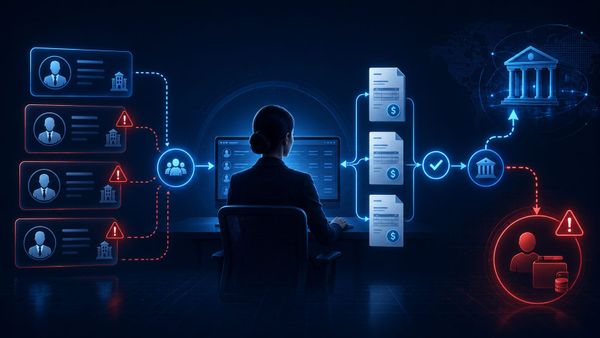
Protection against disbursement fraud begins at vendor enrollment and onboarding. A comprehensive vendor verification process entails:
· Vendor Selection Due Diligence
· Authentication
· Compliance – Sanctions & Barred Party Screening
· Secure Data Gathering and Validation
Selection due diligence — Evaluating whether a vendor is legitimate, financially sound and appropriate to do business with before any relationship begins.
Authentication — Confirming that the entity you are dealing with is who they claim to be, and that the individuals acting on their behalf have the authority to do so.
Compliance screening — Checking the vendor against government sanctions lists, debarment registries, and other exclusion databases — including OFAC's Specially Designated Nationals list — to confirm that doing business with them is legally permissible.
Secure Data Gathering and Validation — Securely collecting requisite information and verifying specific data elements: legal name, tax identification, business registration, ownership structure, and banking information.
These elements work together. A vendor can pass authentication but fail compliance screening. A vendor's identity can be confirmed but their bank account details manipulated in transit. Robust vendor verification requires all these components to function as an integrated process, not a checklist of separate tasks.
Why the Threat Is Escalating
Vendor master file fraud — the manipulation of vendor records to redirect legitimate payments — is among the fastest-growing categories of financial crime targeting organizations. The Association of Certified Fraud Examiners (ACFE) consistently identifies billing schemes (which include fraudulent vendor manipulation) as among the most costly and common forms of occupational fraud.
Cyber-enabled variants have compounded the problem significantly. Business email compromise (BEC) and vendor email compromise (VEC) attacks target the vendor onboarding and updating processes. In a typical scheme, an attacker poses as an existing or prospective vendor and submits a request to change banking details through a convincingly spoofed email or phone call. The FBI's Internet Crime Complaint Center (IC3) reported that BEC schemes caused over $2.9 billion in losses to U.S. organizations in 2023 alone, with vendor impersonation and payment redirect attacks representing a substantial share.
Cyberthreats add to the internal threat that remains serious. The City of San Diego fell victim to a payroll and vendor fraud scheme in which an employee manipulated vendor records over several years, redirecting payments totaling millions before detection. Similar schemes appear with regularity in ACFE case studies and court records — often characterized by insufficient segregation of duties in the vendor master file management process.
The Vendor Lifecycle as a Control Surface
Best practice treats the vendor relationship not as a discrete onboarding event but as a lifecycle with defined control points at each stage.
Pre-onboarding. Before soliciting any vendor information, establish selection criteria. What business need is being met? What risk profile is acceptable? Who has authority to approve a new vendor relationship? For large and direct spend, competitive bidding requirements and conflict-of-interest disclosures should be triggered at this stage, not after a preferred vendor has already been identified. Selection criteria should also be applied to indirect spend.
Onboarding. This is the most control-intensive phase. The organization collects, verifies, and validates vendor information across all four dimensions described above — identity, credentials, banking, and compliance status. The information gathered here populates the vendor master file, which becomes the authoritative record for all subsequent payments. The quality of data entering at this stage determines the integrity of the entire payment process downstream.
Ongoing monitoring. Vendor information is not static. Businesses change ownership, move, open new bank accounts or can become subject to sanctions or debarment after an initial screening cleared them. B est-practice organizations establish periodic re-verification schedules — typically annual for high-value or high-risk vendors — and event-triggered reviews when material changes occur.
Change management. Banking and address changes represent the highest-risk vendor master file transactions. Any request to modify payment routing information for an established vendor should be treated with the same rigor as new vendor onboarding — independent verification via confirmed contact information, not the contact information supplied in the change request itself.
Offboarding. Inactive vendors represent an often-overlooked fraud surface. Former employees and external fraudsters alike have exploited dormant vendor records to create fictitious invoices. Vendor records should be systematically inactivated after a defined period of non-use, with reactivation requiring fresh verification.
Core Control Principles
Several principles cut across every stage of the vendor verification lifecycle.
Independence of verification. The person who initiates a vendor relationship or processes a change request should not be the same person who verifies and approves it. This is basic segregation of duties — but it must extend specifically to vendor master file access. Even organizations with strong invoice approval controls sometimes allow a single individual unrestricted access to vendor setup and modification.
Out-of-band confirmation. Any critical vendor data point — particularly banking information — should be confirmed through a channel that is independent of the one through which it was received. If a vendor submits banking details via email, confirm them by phone using a number sourced independently (from prior correspondence, official website, or public directories), not the number provided in the same communication.
Documentation and audit trail. Every verification action should be documented — what was verified, how, by whom, and when. This serves both internal audit purposes and, in the event of fraud, supports investigation and potential recovery. An undocumented verification is, for practical purposes, no verification at all.
Centralized vendor master file governance. In organizations where vendor data is maintained in multiple systems — ERP, procurement platform, expense management — the risk of inconsistency and unauthorized modifications multiplies. A single authoritative vendor master, with controlled access and change logging, is strongly preferable to distributed records.
Proportionate due diligence. Not all vendors present the same risk. A sole-source supplier of a critical component, paid millions annually, warrants more rigorous verification than an occasional office supply vendor. A tiered approach — with verification requirements calibrated to payment volume, business criticality, and relationship type — allows organizations to allocate their verification resources proportionate to actual risk.
Common Failures and What They Enable
Understanding where verification processes break down is as important as knowing what good practice looks like. Common mistakes include:
Relying on vendor-supplied contact information for verification. If a fraudster submits a fake vendor application with a fake phone number, calling that number to "verify" the application confirms nothing. Verification must use independently sourced contact information.
Treating onboarding as a one-time event. Organizations that verify vendors thoroughly at onboarding but never revisit the records are vulnerable to account takeover and profile modification after the initial screening.
Informal change request processes. Many organizations have rigorous new vendor procedures but handle change requests (address updates, banking changes) informally, through email or phone, without comparable verification requirements.
Inadequate access controls on the vendor master file. Broad write-access to vendor records — sometimes granted to AP clerks, IT administrators or ERP system managers without specific business justification — creates significant fraud opportunity.
OFAC and sanctions screening treated as an afterthought. Organizations subject to U.S. sanctions laws (effectively any organization with U.S. operations or U.S.-dollar transactions) face civil and criminal liability for payments made to sanctioned parties — regardless of whether they knew of the sanctions status. Screening must be systematic, documented and ongoing.
Building a Verification Program That Holds
The organizations that manage vendor fraud risk most effectively share several characteristics. They have written policies that define verification requirements clearly and are enforced consistently. They use technology — not manual processes alone — to screen against sanctions databases, validate tax IDs, and flag anomalies in vendor data. They treat the vendor master file as a sensitive asset with restricted access and complete audit logging. And they have designated ownership: someone is accountable for vendor verification program integrity, not just for processing the transactions it enables.
The articles that follow this overview address each component of vendor verification in depth — due diligence, authentication methods, OFAC and sanctions compliance, and secure onboarding procedures. Taken together, they provide the framework for a verification program that does what it is designed to do: ensure that the organizations receiving your payments are the organizations they claim to be, and that every payment your organization makes is one you authorized, to a party you trust, through a process you control.

Exceptions Handling in Payments
Exceptions are an unavoidable part of the payment process. No matter how strong an organization’s controls may be, situations will arise that fall outside standard workflows. A supplier may submit incomplete information. An invoice may not match a purchase order (PO). Payment may require urgent processing. Banking details may suddenly change. A duplicate payment warning may appear moments before disbursement. The question is not whether exceptions will occur. The question is whether they are ha
Payment Authorization Best Practices
Payment authorization is one of the most critical control points in the entire disbursement process. It is the moment when an organization decides whether funds should leave the business. If weak authorization controls allow fraudulent, duplicate, inaccurate, or unauthorized payment to move forward, the financial and operational consequences can be significant. Strong payment authorization practices help organizations ensure that every payment is legitimate, properly reviewed, accurately docu

Onboarding Controls: Strengthening Security During Vendor Onboarding
Vendor onboarding has become one of the most important, and most targeted, stages in the modern disbursement lifecycle. For many organizations, onboarding represents the moment when a supplier officially enters the financial ecosystem. Vendor records are created. Banking information is collected. Tax documentation is submitted. Payment methods are established. Access permissions are assigned. Workflows are initiated. And ultimately, the organization creates the foundation for future disb
Pre-Payment Controls: Strengthening Security Before Payment Release
The final moment before a payment is released represents one of the most critical stages in the entire disbursement lifecycle. At this point, suppliers have been brought onboard, invoices have been processed, approvals have been completed, and payment files are prepared for execution. To many organizations, the transaction may appear essentially complete. But from a disbursement control perspective, this stage remains one of the highest risk points in the process. Once funds leave the organiCompliance
7 posts
View all
Know Your Business (KYB) Explained
Organizations can no longer afford to treat vendor onboarding as a routine administrative task. The process of verifying who you are doing business with, commonly known as Know Your Business (KYB), has become a foundational control for managing financial risk, ensuring regulatory compliance, and protecting against fraud. For accounts payable (AP), treasury, procurement, and compliance leaders, KYB is more than a regulatory requirement. It is a strategic capability that directly impacts the in
OFAC & Sanctions Compliance
Ensuring that funds are not sent to prohibited individuals, entities, or jurisdictions is a fundamental requirement of effective disbursement control. Regulatory scrutiny around sanctions compliance has intensified, and organizations are expected to implement robust, defensible processes to prevent violations. At the center of these requirements is the Office of Foreign Assets Control (OFAC), which administers and enforces U.S. economic and trade sanctions. For accounts payable (AP), treasury
TIN Matching Requirements
TIN Matching Requirements in Disbursement Controls Accurate vendor data is the foundation of compliant disbursement processes, and at the center of that data is the Taxpayer Identification Number (TIN). Ensuring that vendor TINs are correct, validated, and properly matched to legal names is a regulatory expectation with direct financial implications. For accounts payable (AP), finance, and compliance leaders, TIN matching plays a critical role in meeting Internal Revenue Service (IRS) reporti
Internal Payment Fraud Risks
The Most Familiar Fraud — and the Most Underestimated When organizations think about payment fraud, their attention has increasingly turned outward — to the BEC attacker crafting a convincing wire request, the vendor impersonator with a forged bank letter, the cybercriminal monitoring an email thread for the right moment to redirect a payment. These external threats are real, well-documented, and rightly treated with urgency. But the fraud that has historically caused the most consistent damage
Bank Account Change Scams: The Last Line — and the Most Broken One
The Simplest Fraud with the Highest Body Count Of all the payment fraud schemes that confront accounts payable and treasury functions, phony bank account change scams are, mechanically, among the simplest. An attacker — posing as a vendor, an employee, or an internal colleague — requests a change to banking information on file. The change is processed without independent verification. The next payment goes to the attacker's account instead of the legitimate recipient. By the time anyone notices
Process and Governance Risks
Process and governance risks originate inside the organization. The failures described in this section happen because of how the paying organization has structured its own operations — how duties are divided, how the vendor file is maintained, how invoices are reviewed, how approvals are granted, and how payment timing is managed. When these internal structures are weak, absent, or deliberately circumvented, the disbursement environment becomes the vulnerability rather than the safeguard. This
Disbursement Risk Overview
Most disbursement control programs are built in response to something that already went wrong. A vendor changes banking details and nobody catches it before the wire clears. An employee runs a ghost vendor scheme for two years before an auditor notices the pattern. A payment processor has a data breach and suddenly the organization's banking credentials are in the wrong hands. The controls that exist often reflect the specific failures that prompted them — which means the gaps in the program ref
Third-Party and Technology Intermediary Risks
The first three sections of this risk taxonomy describe threats that operate through recognizable human mechanisms — a vendor whose systems are compromised, an employee who exploits a control gap, a payment that triggers a regulatory prohibition. The risks in this section are different in character. They are embedded in the technology infrastructure that modern disbursement operations depend on: the processors that move funds, the platforms that automate invoice and payment workflows, and the daTechnology & Automation
5 posts
View all
AI & Automation in Disbursement Control: The New Front Line in Payment Fraud Prevention
The conversation around automation in disbursement control has fundamentally changed. Just a few years ago, automation was primarily about efficiency: reducing manual tasks, accelerating invoice processing, and improving throughput. Today, while those benefits still matter, the real driver behind automation investment is far more urgent: fraud prevention. Payment fraud is a constant, evolving threat. Business email compromise (BEC), vendor impersonation, and payment redirection schemes are
Payment System Integration
Disbursement controls are only as strong as the systems that support them, and how well those systems work together. Accounts payable (AP) and finance teams don’t operate in a vacuum. They rely on enterprise resource planning (ERP) systems to manage transactions, banking platforms to execute payments, vendor systems to manage data, and a growing ecosystem of automation tools to improve efficiency. Yet in many organizations, these systems remain loosely connected, or worse, siloed. That fragmen
ERP Gaps and Limitations in Payment Controls
Enterprise resource planning (ERP) systems are the backbone of financial operations. They manage invoices, vendors, approvals, and payments. They centralize data and standardize processes. And for many organizations, they represent the single source of truth for financial activity. But when it comes to disbursement controls, there is a growing, and increasingly dangerous, gap between what ERPs were designed to do and what finance leaders need today. That gap is being exploited. Fraud is moVendor Monitoring
5 posts
View all
Monitoring Sanctions Changes
Sanctions compliance is no longer a static onboarding exercise. In today’s rapidly evolving geopolitical and regulatory environment, organizations must continuously monitor sanctions changes throughout the vendor lifecycle to reduce compliance risk, protect financial operations, and strengthen disbursement controls. A supplier that appears compliant today may become high-risk tomorrow. Governments regularly update sanctions programs. Regulatory agencies continuously add and remove individuals
Bank Account Change Controls
Few areas within accounts payable (AP) and disbursements create more risk than vendor bank account changes. A single fraudulent or improperly validated banking change can redirect large payments into criminal accounts within minutes. Once funds are transferred, particularly through Automated Clearing House (ACH), wire, or real-time payment environments, recovering the money can become extremely difficult. That is why bank account change controls have become one of the most critical components
Vendor Master File Governance
The vendor master file is one of the most important and often one of the most overlooked assets within modern financial operations. Every supplier payment, invoice workflow, tax process, compliance review, procurement transaction, and disbursement control strategy depends on the integrity of vendor master data. Yet in many organizations, the vendor master file remains fragmented, inconsistently managed, poorly monitored, and highly vulnerable to fraud, errors, and operational inefficiencies.Data Validation
5 posts
View all
Vendor Data Validation Explained: Why Accuracy in the Vendor Master Is a Control Imperative
What Vendor Data Validation Is — and What It Is Not Vendor data validation is the systematic process of confirming that the information held in an organization's vendor master file is accurate, complete, current, and trustworthy. It encompasses the verification of banking information, tax identification, business addresses, entity status, and the relationships between related data elements — and it applies not only at the point of vendor onboarding but throughout the life of the vendor relation
Entity Relationship Identification, Verification and Control
Why Entity Relationships Are an Advanced Control Challenge Most vendor data validation controls operate at the level of the individual vendor record. Does this bank account belong to this vendor? Does this TIN match this legal name, does this address correspond to this entity? These are essential controls, and their absence creates serious vulnerability. But they share a common limitation — they evaluate each vendor record in isolation, without reference to the relationships between vendors, be
Beyond OFAC: Foreign Sanctions Screening
Organizations that process payments in currencies other than U.S. dollars, that are incorporated or operate in the UK or EU, or that have vendors with international ownership structures face layered screening obligations under multiple regulatory regimes. OFAC compliance alone is an incomplete sanctions program for any organization with international exposure. The United Kingdom: The UK Sanctions List (UKSL) The United Kingdom's sanctions regime has operated independently from the EU frameworFundamentals
3 posts

A New Framework for Disbursements: Authenticate, Verify, Validate, Monitor, Control
Building the Infrastructure That Keeps Disbursements Trustworthy The foundational premise here is that disbursements are not a back-office formality — they are the final line of defense between your organization's capital and the countless ways it can be misdirected, stolen or lost. We reviewed why disbursement controls matter to an enterprise and what is at stake when there is a failure in their thorough, consistent application. The next logical question is: if disbursements deserve the weigh
Why Disbursement Control Matters
Risk is a part of business. There are many kinds of business risk, which may be defined as anything that threatens the organization’s ability to survive and succeed. There are many kinds of risk, both internally and externally—market risks, employee capabilities, various financial risks—that organizations must recognize and address. Large businesses typically have risk management teams whose job is to avoid major financial losses, while small to mid-size organizations generally have an ad hoc a
What is Disbursement Control?
Disbursements: A Control Function Not an Administrative Task Every dollar that leaves an organization passes through a single chokepoint. It is not the CEO's office. It is not the board of directors. It is accounts payable — the function most executives relegate to back-office status managed by junior staff, measured by invoice cycle times and largely invisible until something goes wrong. And when something goes wrong in accounts payable, it goes wrong at scale. Fraud schemes built on fictitiVendor Verification
2 posts

At the Heart of the Matter: Vendor Authentication, Validation and Verification
Every payment your organization makes begins with a decision made long before the invoice arrives: the decision to trust a vendor. That trust, if poorly established, becomes a liability — a gap in your controls that fraudsters exploit and auditors flag. Vendor verification is how organizations convert trust from assumption into evidence. For CFOs and Controllers, vendor authentication, validation and verification are not a procurement formality. They are foundational disbursement controls — the
Vendor Selection & Due Diligence: Authenticating the Vendor
Before a single invoice is approved, accounts payable must have established that the vendor is who it claims to be, that it is authorized to receive payment, and that its risk profile is commensurate with what is being purchased. The disbursement of funds through accounts payable is not a clerical act. It is the terminal point of a control system whose integrity depends, above all, on one foundational question: is this vendor legitimate? Vendor selection and due diligence are not procurement fuData Integrity
2 posts

Vendor Address Verification Methods: Why Address Data Matters in the AP Control Framework
Address Verification as a Control, not a Formality Vendor address verification is frequently treated as a routine data quality exercise — a matter of ensuring that checks reach their destination and that 1099s are mailed to the right place. That framing understates both the control value and the fraud detection utility of address verification in a well-governed accounts payable program. A vendor's address is more than a mailing coordinate. It is a corroborating data point that either supports
Bank Account Validation & Verification Guide: Methods, Controls, and Best Practices for Accounts Payable
Why Bank Account Validation Is the Most Critical Control in Vendor Management Of all the data elements in a vendor master file, bank account information is the single most operationally consequential — and the single most frequently targeted by fraud. It is the field that determines where money goes. An error in a vendor's name or address is a record-keeping problem. An error in a vendor's bank account number — whether caused by data entry mistake, process failure or deliberate criminal manipulSanctions
1 post

Beyond OFAC: Foreign Screening Obligations
Organizations that process payments in currencies other than U.S. dollars, that are incorporated or operate in the UK or EU, or that have vendors with international ownership structures face layered screening obligations under multiple regulatory regimes. OFAC compliance alone is an incomplete sanctions program for any organization with international exposure. The United Kingdom: The UK Sanctions List (UKSL) The United Kingdom's sanctions regime has operated independently from the EU frameworOFAC
1 post

OFAC (Sanctions) Screening & Barred Parties
The Legal Obligation No AP Function Can Delegate OFAC sanctions operate on strict liability. Ignorance of a vendor's sanctioned status is not a defense. For accounts payable, this means that screening against the SDN list and all applicable international watchlists is not a best practice — it is a legal duty that attaches before the first payment is authorized. Accounts payable sits at the terminal point of the disbursement cycle — the moment at which an obligation becomes a payment and orgaVendor Onboarding
1 post