
Third-Party and Technology Intermediary Risks
The first three sections of this risk taxonomy describe threats that operate through recognizable human mechanisms — a vendor whose systems are compromised, an employee who exploits a control gap, a payment that triggers a regulatory prohibition. The risks in this section are different in character. They are embedded in the technology infrastructure that modern disbursement operations depend on: the processors that move funds, the platforms that automate invoice and payment workflows, and the data services and APIs that connect financial systems to banking networks. The threat here is not primarily a bad actor inside the organization or a compromised vendor relationship. It is the possibility that the infrastructure itself — the intermediary layer between the paying organization and its bank — introduces vulnerabilities, failures, or dependencies that the organization has not adequately evaluated or controlled.
This category of risk has grown substantially as disbursement operations have modernized. Twenty years ago, a mid-sized organization's payment infrastructure was largely its bank relationship and its internal accounting system. Today, the same organization may use a third-party AP automation platform, a payment processing service that sits between its ERP and its bank, one or more fintech solutions for specific payment types, a data aggregation service for bank connectivity, and an API integration layer that connects several of these together. Each layer introduces its own risk surface. Each third-party relationship represents a dependency. And the combined complexity of the stack creates exposure that no single point of control can fully address.
What makes third-party and technology intermediary risk particularly challenging to manage is that much of it is not directly visible to the finance function. AP teams can see their invoices, their approval queues, their payment runs. They typically cannot see the security architecture of the platform processing those workflows, the contractual protections governing the processor handling their ACH files, or the data retention practices of the aggregator service connecting their systems to their bank. Managing this risk requires a combination of procurement discipline, contractual rigor, and technical oversight that crosses organizational boundaries — involving finance, IT, legal, and information security in ways that disbursement risk management has not traditionally required.
Payment Processor and Fintech Vendor Risk
Payment processors and fintech vendors occupy a critical position in the disbursement infrastructure of many organizations. They sit between the paying organization and the banking network, handling the actual movement of funds through ACH, wire, card, and increasingly real-time payment rails. Their operational reliability directly determines whether payments clear on time. Their security practices directly determine whether payment data moving through their systems is protected. And their financial stability directly affects whether the organizations depending on them can continue operating if they fail.
The risk profile of payment processors and fintech vendors is multi-dimensional. Operational risk is the most immediately visible: a processor that experiences an outage, a processing error or a settlement delay creates direct disbursement disruption for every customer depending on that processor at that moment. For organizations with time-sensitive payment obligations — payroll, tax payments, vendor terms with contractual payment dates — processor downtime is not just inconvenient, it creates financial and legal exposure.
Security risk is less immediately visible but potentially more consequential. Payment processors handle large volumes of sensitive financial data: bank account numbers, routing information, transaction details, and in some cases authentication credentials. A security breach at a processor level exposes not just one organization's data but the data of every customer the processor serves. The concentration of sensitive payment data in third-party systems creates a target that attracts sophisticated attacks, and the security controls governing those systems are often opaque to the organizations that depend on them.
The fintech segment introduces additional dimensions of risk that are less characteristic of traditional payment processors. Fintech vendors frequently operate under regulatory frameworks that are newer, less settled, and in some cases still developing — creating compliance uncertainty that can affect both the vendor's operations and the organizations using their services. Many fintech companies are relatively young, with limited track records of operational resilience across market cycles. Some operate with business models that have not yet demonstrated sustainable unit economics, creating the possibility of abrupt service discontinuation that leaves customers stranded mid-migration or dependent on a platform that is no longer being actively maintained.
Third-party risk management for payment processors and fintech vendors requires evaluation at the point of selection and ongoing monitoring through the relationship.
Third-party risk management for payment processors and fintech vendors requires evaluation at the point of selection and ongoing monitoring through the relationship. Due diligence should cover financial stability, regulatory standing, security certifications and audit reports, business continuity capabilities, and contractual protections around data ownership, liability allocation, incident notification and service level commitments. For critical payment infrastructure, continuity planning should explicitly address what happens if the processor fails — because the time to identify an alternative is not during an outage or an insolvency proceeding.
Contractual protections deserve particular attention in fintech relationships, where the negotiating dynamic often favors the vendor and standard terms may be inadequate. Data portability provisions — the ability to extract your data in a usable format if the relationship ends — are essential but frequently absent from standard fintech agreements. Liability caps, incident notification timelines and sub-processor disclosure requirements are areas where the standard contract may not reflect what the organization actually needs. These terms are negotiable, especially for organizations representing material revenue to the vendor, and the negotiation is worth having before the contract is signed rather than after something goes wrong.
AP Automation Platform Vulnerabilities
AP automation platforms — the software systems that manage invoice receipt, coding, approval routing, and payment initiation — have become core infrastructure for most organizations with meaningful invoice volumes. They deliver genuine operational benefits: faster processing, reduced manual effort, better audit trails, and improved visibility into the payables pipeline. They also introduce a vulnerability surface that is directly relevant to disbursement risk, and that is not always adequately evaluated when these platforms are selected and implemented.
The vulnerability profile of AP automation platforms has several distinct dimensions. Access control configuration is the most operationally significant. These platforms manage the approval and payment authorization workflow, which means their access control architecture determines who can do what in the disbursement process. Misconfiguration — roles with excessive permissions, approval workflows that can be bypassed under certain conditions, administrative accounts with payment initiation capability, inadequate separation between system administration and financial transaction authority — can undermine the segregation of duties controls that the organization believes are functioning. The platform may be technically capable of enforcing proper controls, but if it is not configured to do so, it provides the appearance of control without the substance.
Misconfiguration ... can undermine the segregation of duties controls that the organization believes are functioning.
Integration security is a second dimension. AP automation platforms typically integrate with ERP systems, banking portals, document management systems, and in some cases vendor portals and procurement platforms. Each integration point is a potential vulnerability: data transmitted between systems can be intercepted if not properly encrypted, authentication between systems can be exploited if credentials are weak or shared, and errors in integration logic can result in data corruption or payment misdirection that is difficult to detect until the downstream effect becomes visible. Integration security requires ongoing attention — integrations that were properly configured at implementation can develop vulnerabilities as software are updated, as credentials age or as the surrounding security environment changes.
Vendor portal functionality, where AP platforms provide external access for vendors to submit invoices or update information, may be an additional risk surface. A vendor portal with weak authentication controls is a potential entry point for attackers.
Platform update and patch management creates a more technical but equally real vulnerability. AP automation platforms, like all software systems, require ongoing security patches and updates. Organizations that fail to maintain current versions, or that operate heavily customized implementations that cannot be updated without breaking customizations, accumulate security debt over time.
Vendors of AP automation software regularly issue security updates in response to discovered vulnerabilities — an organization that is running a version from two years prior may be exposed to vulnerabilities that have been publicly disclosed and for which exploits are available.
The governance implication is that AP automation platform security is not purely an IT responsibility. Finance owns the process that the platform supports, and finance leadership needs sufficient visibility into the platform's security posture — its configuration, its access controls, its integration security, its update status — to evaluate whether the controls the organization believes are in place are functioning. That visibility requires collaboration between finance, IT and information security, and in many organizations it requires a deliberate effort to establish, because the default operating model treats the platform as IT infrastructure and the financial controls as finance's concern, without adequately connecting the two.
Data Aggregator and Banking API Risk
The third category of technology intermediary risk involves the services and connectivity layers that link financial systems to banking networks. Data aggregators — services that connect to banking institutions to retrieve account data, transaction history and balance information — and banking APIs — the interfaces through which financial systems directly communicate with bank platforms — have become foundational components of modern treasury and AP infrastructure. They enable real-time visibility, automated reconciliation and streamlined payment initiation. They also introduce a category of risk that is relatively new to the disbursement risk conversation and not yet systematically managed in many organizations.
The core risk with data aggregators is credential exposure. Traditional data aggregation services operated by having customers provide their banking credentials to the aggregator, which then used those credentials to access bank portals on the customer's behalf — a practice known as screen scraping. Handing banking credentials to a third party creates obvious exposure: if the aggregator's systems are breached or if the aggregator's security practices are inadequate, those credentials are compromised. Modern API-based connectivity has largely addressed this problem for major banking relationships, using token-based authentication standards that allow data access without credential sharing — but legacy aggregation relationships using credential-based methods persist in many environments, and the transition to API-based connectivity is not universal.
Banking APIs introduce their own risk profile. The security of the API connection — the authentication mechanisms, the encryption of data in transit, the authorization controls governing what the API can initiate — directly affects the security of any financial transaction that flows through it. API keys and tokens are credentials, and like all credentials they require careful management: appropriate storage, rotation practices, access restrictions, and monitoring for anomalous usage. An API key with payment initiation capability that is stored insecurely, shared across systems that don't all require that level of access, or never rotated is a persistent vulnerability in the payment infrastructure.
The open banking regulatory environment adds a layer of complexity in jurisdictions where it applies. Open banking frameworks — which mandate bank API access for licensed third parties — expand the ecosystem of services that can access financial account data and initiate payments on behalf of account holders. The benefits are real, but so are the risks: more third parties with data access means more points of potential exposure, and the regulatory frameworks governing open banking third parties vary significantly in their security requirements and their enforcement.
Concentration in data aggregation and banking API services is a risk dimension that is rarely evaluated explicitly but deserves attention. A small number of major aggregators serve a significant portion of the commercial market. If a major aggregator experiences a service disruption, security incident or regulatory action affecting its operations, the downstream effect on the organizations depending on it for bank connectivity can be substantial. This concentration dynamic is analogous to the payment processor concentration risk described above, but it is less visible because the aggregator relationship is often perceived as infrastructure rather than as a critical dependency with its own risk profile.
The practical control framework for data aggregator and banking API risk involves a combination of technical standards and governance practices.
On the technical side: API-based connectivity should be preferred over credential-based aggregation where available; API credentials should be managed with the same rigor applied to other privileged access credentials; API access should be scoped to the minimum necessary permissions for the specific use case; and API activity should be logged and monitored for anomalous patterns.
On the governance side: third-party relationships with data aggregators should be subject to the same due diligence and contractual review applied to other critical technology vendors; the organization should understand what data each aggregator can access and how that data is protected; and continuity planning should address the possibility of aggregator service disruption.
The Stack as a System
Individually, each of the three risk areas in this section is manageable with the right combination of due diligence, contractual protection, technical controls, and monitoring. The more challenging problem is the combined effect of a disbursement technology stack in which multiple third parties interact, each managing different portions of the payment workflow, none of them having full visibility into what the others are doing or how the overall system behaves under stress or attack.
A payment that originates in an AP automation platform, is validated against bank account data retrieved through a data aggregator and is ultimately transmitted through a payment processor involves at least three third-party systems and multiple integration points — any of which can be a point of failure or a point of attack. The organization's control framework needs to account for the whole stack, not just for each component individually. That requires someone — whether in IT, information security, treasury, or finance operations — who has a complete picture of the technology infrastructure through which disbursements flow and is responsible for its overall security and resilience.
In many organizations, that comprehensive view doesn't exist. The AP platform is managed by the finance team. The banking APIs are managed by treasury. The integration layer is managed by IT. The data aggregator relationship was established years ago and is no longer actively reviewed by anyone. The aggregate exposure of that fragmented governance model is greater than the sum of its parts — because the gaps between organizational owners are precisely where systemic vulnerabilities tend to accumulate.
What's Next?

Strategic and Reputational Risks
The sections preceding this one describe risks that are, in various ways, operational in nature. Fraud schemes, control failures, regulatory violations, technology vulnerabilities — these are problems that manifest in specific transactions, specific systems or specific compliance failures. They can be investigated, quantified, remediated and in most cases contained. The organization identifies what went wrong, fixes it, and moves forward. Strategic and reputational risks are different. They are
Regulatory, Compliance, and Legal Risks
The risks in the previous two sections — internal process breakdowns and vendor-resident failures — share a common characteristic: something goes wrong, money is lost or misdirected, and the harm is primarily financial. Regulatory, compliance, and legal risks operate differently. Here, a payment can be made correctly in every operational sense — properly authorized, accurately recorded, delivered to the intended recipient — and still expose the organization to penalties, criminal liability, repu
Process and Governance Risks
Process and governance risks originate inside the organization. The failures described in this section happen because of how the paying organization has structured its own operations — how duties are divided, how the vendor file is maintained, how invoices are reviewed, how approvals are granted, and how payment timing is managed. When these internal structures are weak, absent, or deliberately circumvented, the disbursement environment becomes the vulnerability rather than the safeguard. This
Disbursement Risk Overview
Most disbursement control programs are built in response to something that already went wrong. A vendor changes banking details and nobody catches it before the wire clears. An employee runs a ghost vendor scheme for two years before an auditor notices the pattern. A payment processor has a data breach and suddenly the organization's banking credentials are in the wrong hands. The controls that exist often reflect the specific failures that prompted them — which means the gaps in the program ref
Regulatory, Compliance, and Legal Risks
The risks in the previous two sections — internal process breakdowns and vendor-resident failures — share a common characteristic: something goes wrong, money is lost or misdirected, and the harm is primarily financial. Regulatory, compliance, and legal risks operate differently. Here, a payment can be made correctly in every operational sense — properly authorized, accurately recorded, delivered to the intended recipient — and still expose the organization to penalties, criminal liability, repu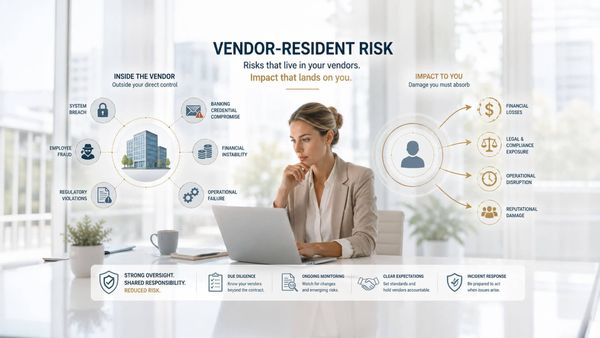
Vendor-Resident Risks
There is a category of disbursement risk that receives less systematic attention than it deserves, largely because it originates outside the paying organization's direct control. These are risks that live inside the vendor — in their systems, their people, their finances and their business practices — but that transfer financial, legal or operational harm directly to their customer. The paying organization didn't create the problem. It still absorbs the consequences. Understanding vendor-reside
Onboarding Controls: Secure Vendor Onboarding
The Onboarding Moment Is a Control Moment Vendor onboarding is the point at which a new payment relationship is established — and it is one of the highest-risk moments in the entire accounts payable lifecycle. It is the moment when vendor identity is either verified or assumed, when banking information is either authenticated or taken on faith, and when the controls either hold or fail. What happens at onboarding sets the risk profile for every payment that follows. Despite this, many organiza
Know Your Business (KYB) Explained
Organizations can no longer afford to treat vendor onboarding as a routine administrative task. The process of verifying who you are doing business with, commonly known as Know Your Business (KYB), has become a foundational control for managing financial risk, ensuring regulatory compliance, and protecting against fraud. For accounts payable (AP), treasury, procurement, and compliance leaders, KYB is more than a regulatory requirement. It is a strategic capability that directly impacts the in