Vendor-Resident Risks
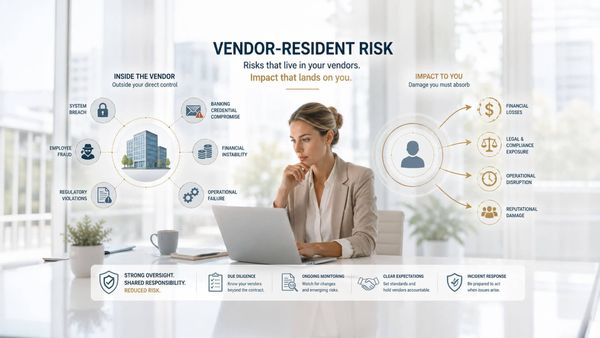
There is a category of disbursement risk that receives less systematic attention than it deserves, largely because it originates outside the paying organization's direct control. These are risks that live inside the vendor — in their systems, their people, their finances and their business practices — but that transfer financial, legal or operational harm directly to their customer. The paying organization didn't create the problem. It still absorbs the consequences.
Understanding vendor-resident risk requires a shift in perspective. Many internal control frameworks were designed around the question of what employees might do wrong. Vendor-resident risk asks a different question: what can go wrong on the other side of the transaction, and how does that harm flow back to you? The answer spans a surprisingly wide range — from stolen bank credentials, to employee fraud inside the vendor, to regulatory violations that create downstream liability for every customer the vendor serves.
What can go wrong on the vendor side of the transaction, and how does that harm flow back to you?
The risks described in this section don't all operate the same way. Some are primarily financial. Some are operational. Some create legal exposure that is invisible at the point of payment and only surfaces during an audit or enforcement action. What they share is the mechanism of transfer: the harm originates with the vendor but lands on the customer.
Vendor Banking Credential Compromise
When a vendor's banking credentials are compromised — through phishing, email account takeover (vendor email compromise), insider theft or system breach — the most common result is that the attacker redirects legitimate customer payments to a fraudulent account. The customer pays. The vendor never receives the funds. And the paying organization is left holding a transaction it believed was legitimate.
This is one of the most reliably damaging fraud patterns in business payments, and it works precisely because it exploits the trust that exists in an established vendor relationship. The attacker doesn't need to impersonate a stranger. They compromise the vendor's email or systems, monitor communications until a payment opportunity arises, and then substitute their own banking details — either by sending a fraudulent change notification that appears to come from the vendor, or by intercepting and modifying an actual vendor communication.
The paying organization's exposure here is significant and underappreciated. In most cases, the funds are not recoverable. Wire transfers are final. ACH reversals have narrow windows and no guarantee of success. If the fraud involves a domestic account that is quickly emptied, or an international transfer, recovery approaches zero. Courts have generally found that the paying organization — not the bank, and not the vendor — bears the loss when it authorized a payment based on fraudulent instructions it received, even if it received them in good faith.
What makes this risk particularly difficult to manage through traditional controls is that nothing about the payment process itself looks wrong.
What makes this risk particularly difficult to manage through traditional controls is that nothing about the payment process itself looks wrong. The invoice may be genuine. The approval workflow may have been followed correctly. The payment may match the purchase order. The only thing that changed was the bank account number, and in most AP environments that change receives little scrutiny — especially if it arrives with a plausible explanation and appears to come from a known contact.
Effective controls focus on the point of change. Banking detail modifications should require independent verification through a channel entirely separate from the one that delivered the request — for example, a callback to a phone number on file, not the one provided in the email. Requests to change banking information should be treated as high-risk events regardless of who appears to be making them and should require multiple points of confirmation before the change is activated in the master vendor file.
Vendor-side controls matter too, and organizations with significant vendor relationships should consider making basic cybersecurity expectations — email security practices, access controls, incident notification obligations — part of vendor service agreements. A vendor whose email system is easily compromised is a recurring fraud risk for every customer they have.
Vendor Internal Fraud
Vendor internal fraud refers to fraudulent activity committed by the vendor's own employees that results in financial harm to the customer. It is structurally distinct from vendor banking credential compromise in that the perpetrator is an insider, not an external attacker — but the harm mechanism is similar: the customer pays money they should not have paid, or does not receive value for money they legitimately paid.
The most common forms include invoice inflation, where a vendor employee manipulates billing to overcharge customers — either by inflating unit prices, adding services not rendered, or duplicating charges across billing cycles. Kickback arrangements, where a vendor employee colludes with a customer employee to approve inflated or fictitious invoices in exchange for personal benefit, represent a more complex variant that involves misconduct on both sides of the transaction. Advance payment diversion, where vendor employees misdirect customer deposits or prepayments before services are delivered, is particularly damaging because the customer's leverage disappears the moment the funds transfer.
What distinguishes vendor internal fraud from simple billing errors is intent and pattern. A single incorrect invoice may be a mistake. A systematic pattern of overcharges that persist across billing cycles, that correlate with particular employees on the vendor side, or that involve charges for services with no corresponding deliverable documentation is something else. The challenge for the paying organization is that it typically has limited visibility into the vendor's internal operations, making detection dependent on invoice scrutiny, contract compliance reviews, and occasionally whistleblower disclosures.
A single incorrect invoice may be a mistake. A systematic pattern ... is something else.
The control response is primarily analytical. Rigorous three-way matching — purchase order, receiving documentation, and invoice — catches many forms of invoice inflation. Regular audits of vendor billing against contracted rates and delivered scope identify discrepancies before they compound. Contract terms that grant audit rights give the paying organization formal standing to examine vendor records when patterns raise concerns. And vendor onboarding due diligence that includes checking for fraud history, ownership structure, and employee conflicts of interest reduces the likelihood of entering into relationships where the risk is elevated from the start.
It's worth noting that vendor internal fraud and customer-side fraud are not always independent. Kickback schemes by definition require a corrupt relationship between a vendor employee and a customer employee. This means vendor internal fraud is also a signal to look inward — when suspicious billing patterns are identified, the question isn't only what the vendor did, but who inside your organization was approving it.
Vendor Cybersecurity Inadequacy
Beyond banking credential compromise, which is a specific fraud pattern, there is a broader category of risk that arises when a vendor's cybersecurity posture is inadequate and that inadequacy creates exposure for customers. This can take several forms: customer data held by the vendor is breached, payment information transmitted through vendor systems is intercepted, vendor platforms used for invoicing or payment processing become vectors for malware or credential harvesting, or vendor systems are compromised in ways that disrupt services the customer depends on.
The financial services and government sectors have been more systematic than most about evaluating vendor cybersecurity as a component of third-party risk management. In commercial finance operations, the discipline is less consistently applied, and many AP environments interact with vendor systems — invoicing portals, procurement platforms, expense management tools — without any formal assessment of the security practices governing those systems.
The exposure is real and growing. As more disbursement activity moves through digital platforms and automated workflows, the attack surface that exists within the vendor ecosystem expands. An invoice portal with weak authentication controls is a potential point of entry. A vendor that stores customer banking and payment data without adequate encryption is a liability waiting to materialize. A vendor who uses the same credentials across systems, or whose employees lack training on phishing, creates risk that extends to every customer relationship they maintain.
For financial operations leaders, the practical response involves building cybersecurity expectations into vendor contracts.
For financial operations leaders, the practical response involves building cybersecurity expectations into vendor contracts — particularly for vendors who handle payment data, have access to financial systems, or operate platforms through which disbursements flow. Vendor security questionnaires at onboarding, periodic reassessment for high-risk vendors, and contractual requirements around breach notification timelines are baseline practices. For critical vendors with deep system integration, more thorough assessments — including review of SOC 2 reports or equivalent — are warranted.
This is an area where the control investment should be proportional to the access and data exposure involved. A vendor who receives a check by mail creates minimal cybersecurity risk. A vendor who has API access to your ERP system, or who operates the platform through which all your invoices are processed, represents a fundamentally different risk profile and warrants a fundamentally different level of scrutiny.
Vendor Financial Distress (Advance Payment and Deposit Risk)
When a vendor is in financial distress — whether the customer knows it or not — the risk profile of every transaction with that vendor changes. The clearest manifestation of this risk involves advance payments and deposits: funds transferred to the vendor before goods are delivered or services are rendered. If the vendor fails before performing, those funds are gone, and the paying organization becomes an unsecured creditor in whatever insolvency proceeding follows.
Advance payment risk is not hypothetical. It appears regularly in construction disputes, technology implementation failures, and service contracts where significant upfront fees are standard. It also appears in procurement relationships where customers agree to prepay for inventory or raw materials as a condition of supply — arrangements that can shift from reasonable business practice to significant financial exposure when the vendor's financial condition deteriorates.
The problem is compounded by the fact that vendor financial distress is often not visible to customers until it is too late to act. Vendors have strong incentives to conceal deteriorating financial conditions, particularly when advance payments from customers are helping to fund operations. By the time insolvency is publicly known, the money is usually gone.
The control response requires proactive financial monitoring of vendors who hold significant advance payments or deposits, and structural negotiation around payment terms for relationships where large upfront transfers are unavoidable. Payment bonds and performance guarantees can provide contractual protection in construction and major procurement contexts. Escrow arrangements, where advance funds are held by a neutral third party and released upon milestone completion, are appropriate in higher-risk transactions. For ongoing vendor relationships, periodic review of financial health indicators — credit reports, public filings, payment behavior with other creditors — provides early warning before exposure becomes unmanageable.
There is also a due diligence dimension at the front end. Advance payment terms should not be agreed to without some assessment of the vendor's financial stability. A vendor requesting unusually large deposits, or whose payment terms have shifted to require more upfront commitment over time, may be signaling a financial condition worth investigating before funds transfer.
Vendor Misrepresentation and Scope Creep Billing
This category sits at the intersection of vendor fraud and vendor performance management, and the line between them matters for how the paying organization responds. Misrepresentation involves a vendor making material false statements — about capabilities, credentials, certifications, the qualifications of personnel, or the nature of services to be provided — that induce the customer to enter a contract or approve payments on false premises. Scope creep billing involves a vendor systematically billing for work outside the contracted scope, either through deliberate expansion of what is invoiced or through a gradual erosion of contract boundaries that the customer fails to enforce.
Both create financial harm. Misrepresentation can result in payments for services that were not what they were represented to be — or in outcomes that are materially worse than what was contracted, requiring costly remediation. Scope creep billing results in the customer paying more than the contract contemplated, often without clear awareness that the boundaries have shifted.
Misrepresentation risk is highest at the beginning of a vendor relationship, in competitive procurement situations where vendors have incentive to overstate capabilities, and in specialized or technical service categories where the customer has limited ability to independently assess vendor claims. The control response is due diligence — credential verification, reference checks, and contract terms that require documentation of qualifications and that establish clear remedies for misrepresentation.
Scope creep billing is an ongoing operational risk that requires active contract management rather than a one-time control. Clear scope definitions in the original contract, documented change order processes that require explicit approval before out-of-scope work is performed or billed, and regular reconciliation of invoices against approved scope are the core defenses. In complex service relationships — consulting, IT services, construction, managed services — scope creep is often gradual enough that no single invoice triggers review, but the cumulative impact over a contract period can be substantial.
What elevates scope creep from a performance management issue to a fraud issue is intent and pattern. A vendor who consistently bills for work that was never authorized, who resists change order documentation, or whose invoices systematically obscure the distinction between in-scope and out-of-scope work may be engaged in deliberate overbilling rather than ambiguous interpretation of the contract. The response in that case moves from contract management to formal dispute and, depending on the amounts involved, potential legal action.
Vendor Tax and Regulatory Non-Compliance
The final category of vendor-resident risk is in some ways the least intuitive: the paying organization can incur legal and financial liability as a result of the vendor's failure to meet its own tax and regulatory obligations. This exposure operates through several mechanisms, and understanding them is important because the liability can be both significant and genuinely invisible at the point of payment.
The most direct mechanism is tax withholding. In the United States, payments to vendors who fail to provide valid taxpayer identification information — or who are identified by the IRS as subject to backup withholding — create an obligation for the paying organization to withhold a percentage of payment. Failure to do so can result in the paying organization being held liable for the unwithheld tax. Proper W-9 collection and TIN verification at onboarding is the standard control, but it requires active enforcement and periodic refreshment as vendor information changes.
Misclassification liability ... can fall on the paying organization even when the misclassification was structured by the vendor.
Worker classification is a related but distinct exposure. Organizations that engage vendors providing individual contractor services face risk if the IRS or a state tax authority determines that those individuals were actually employees rather than independent contractors. Misclassification liability — for unpaid employment taxes, benefits, and penalties — can fall on the paying organization even when the misclassification was structured by the vendor. This is particularly relevant for staffing arrangements, consulting relationships, and gig-economy sourcing.
Sales tax and use tax compliance creates additional complexity in multi-state and cross-border procurement. If a vendor fails to collect and remit applicable sales tax, the customer may face use tax liability — an obligation to self-report and pay the tax that should have been collected. This is a low-visibility risk that often surfaces only during a state tax audit.
Beyond tax, regulatory non-compliance by vendors can create reputational and legal exposure for customers, particularly in industries with supply chain due diligence obligations — conflict minerals reporting, labor practice standards, environmental compliance in regulated industries. The extent of this exposure varies by industry and regulatory context, but it is growing as supply chain transparency requirements expand.
The control framework for this category is primarily one of onboarding rigor and ongoing monitoring: proper tax documentation collection, TIN verification, worker classification review for contractor arrangements, and contract terms that allocate responsibility for tax compliance to the vendor and require indemnification for failures. For regulated industries with supply chain compliance obligations, vendor certifications and periodic audit rights are additional tools.
The Common Thread
What connects these six risks is not just that they originate with the vendor — it's that they require the paying organization to extend its risk management thinking beyond the boundaries of its own operations. Traditional disbursement controls are largely inward-facing. They are designed to govern what your own people do with your own systems and your own money. Vendor-resident risks require outward-facing controls: due diligence practices, contractual protections, monitoring capabilities, and verification procedures that extend into the vendor relationship itself.
This doesn't mean treating every vendor as a threat. Most vendors are operating in good faith, and an adversarial posture toward the vendor base is both operationally unworkable and commercially counterproductive. What it means is recognizing that the risk landscape includes things you cannot directly observe, and designing a control program accordingly. The goal is appropriate visibility — enough to detect and respond to the vendor-side failures that, left undetected, transfer their cost directly to you.
What's Next?

Regulatory, Compliance, and Legal Risks
The risks in the previous two sections — internal process breakdowns and vendor-resident failures — share a common characteristic: something goes wrong, money is lost or misdirected, and the harm is primarily financial. Regulatory, compliance, and legal risks operate differently. Here, a payment can be made correctly in every operational sense — properly authorized, accurately recorded, delivered to the intended recipient — and still expose the organization to penalties, criminal liability, repu
OFAC (Sanctions) Screening & Barred Parties
The Legal Obligation No AP Function Can Delegate OFAC sanctions operate on strict liability. Ignorance of a vendor's sanctioned status is not a defense. For accounts payable, this means that screening against the SDN list and all applicable international watchlists is not a best practice — it is a legal duty that attaches before the first payment is authorized. Accounts payable sits at the terminal point of the disbursement cycle — the moment at which an obligation becomes a payment and orga
Process and Governance Risks
Process and governance risks originate inside the organization. The failures described in this section happen because of how the paying organization has structured its own operations — how duties are divided, how the vendor file is maintained, how invoices are reviewed, how approvals are granted, and how payment timing is managed. When these internal structures are weak, absent, or deliberately circumvented, the disbursement environment becomes the vulnerability rather than the safeguard. This
Disbursement Risk Overview
Most disbursement control programs are built in response to something that already went wrong. A vendor changes banking details and nobody catches it before the wire clears. An employee runs a ghost vendor scheme for two years before an auditor notices the pattern. A payment processor has a data breach and suddenly the organization's banking credentials are in the wrong hands. The controls that exist often reflect the specific failures that prompted them — which means the gaps in the program ref
Third-Party and Technology Intermediary Risks
The first three sections of this risk taxonomy describe threats that operate through recognizable human mechanisms — a vendor whose systems are compromised, an employee who exploits a control gap, a payment that triggers a regulatory prohibition. The risks in this section are different in character. They are embedded in the technology infrastructure that modern disbursement operations depend on: the processors that move funds, the platforms that automate invoice and payment workflows, and the da
Regulatory, Compliance, and Legal Risks
The risks in the previous two sections — internal process breakdowns and vendor-resident failures — share a common characteristic: something goes wrong, money is lost or misdirected, and the harm is primarily financial. Regulatory, compliance, and legal risks operate differently. Here, a payment can be made correctly in every operational sense — properly authorized, accurately recorded, delivered to the intended recipient — and still expose the organization to penalties, criminal liability, repu
Onboarding Controls: Secure Vendor Onboarding
The Onboarding Moment Is a Control Moment Vendor onboarding is the point at which a new payment relationship is established — and it is one of the highest-risk moments in the entire accounts payable lifecycle. It is the moment when vendor identity is either verified or assumed, when banking information is either authenticated or taken on faith, and when the controls either hold or fail. What happens at onboarding sets the risk profile for every payment that follows. Despite this, many organiza
Know Your Business (KYB) Explained
Organizations can no longer afford to treat vendor onboarding as a routine administrative task. The process of verifying who you are doing business with, commonly known as Know Your Business (KYB), has become a foundational control for managing financial risk, ensuring regulatory compliance, and protecting against fraud. For accounts payable (AP), treasury, procurement, and compliance leaders, KYB is more than a regulatory requirement. It is a strategic capability that directly impacts the in